
Living in Toronto is expensive. From soaring rent prices in Liberty Village to the cost of groceries in North York, Torontonians are constantly looking for ways to trim their monthly budget. Yet, for decades, one bill has remained stubbornly high and frustratingly inflexible: cable TV.
If you live in the Greater Toronto Area (GTA), you are likely locked into a duopoly. You pay upward of $120 to $180 a month to either Rogers or Bell for a “VIP Package” filled with channels you never watch, just to get the few sports and news channels you actually want.
In 2026, this model is obsolete. A massive shift is happening across the city, from downtown condos to suburban homes in Scarborough and Etobicoke. Torontonians are cutting the cord in record numbers and switching to IPTV (Internet Protocol Television).
But the world of IPTV can be the “Wild West.” Is it legal? Why does your neighbour’s stream buffer during the Leafs game? And do you need that weird Android box sold at the flea market?
This guide is written specifically for the Toronto market. We will cut through the noise, explain the local challenges (like ISP throttling and sports blackouts), and show you how to get a premium, cable-like experience for a fraction of the price.
Part 1: What is IPTV and Why is Toronto Obsessed?
At its simplest, IPTV delivers television content over the internet rather than through traditional terrestrial, satellite signal, or cable formats. If you watch Netflix, YouTube, or Prime Video, you are already using a form of streaming video. IPTV just takes that technology and applies it to live broadcast TV channels.
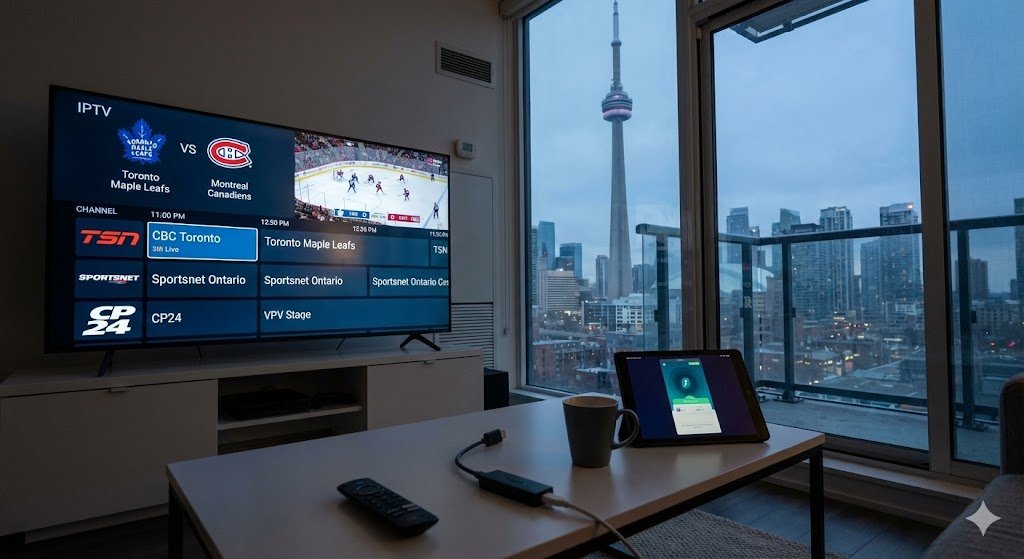
Instead of a coaxial cable plugged into the wall, your TV connects to your home WiFi, and an app on your device connects to a server that streams live feeds of CBC Toronto, CP24, Sportsnet, TSN, CNN, HBO, and thousands more.
Why the GTA is the Perfect Market for IPTV
Toronto’s unique demographics make IPTV not just a cheaper alternative, but a better product than traditional cable.
1. The High Cost of Living
This is the obvious one. When you are paying Toronto rent or mortgage prices, freeing up $100+ a month by cancelling cable is a significant financial relief. That’s over $1,200 a year back in your pocket.
2. Toronto’s Diverse Population
Toronto is one of the most multicultural cities in the world. Traditional cable providers offer pitiful “international packages” that cost an extra $20 for five mediocre channels. Premium IPTV services cater to this diversity. Whether your family wants to watch channels from India, the Philippines, Italy, Portugal, or the Caribbean, a good IPTV subscription offers thousands of international channels included in the base price, allowing residents to stay connected to their home countries easily.
3. The Condo Lifestyle
Many new condos in downtown Toronto are built without traditional coaxial cable infrastructure easily accessible in every room, relying instead on high-speed fibre internet. IPTV is a natural fit for modern condo living—no wires, no bulky boxes, just a Firestick plugged into the back of a wall-mounted TV.
Part 2: The Toronto Sports Fan’s Dilemma (Solving Blackouts)
If you are a sports fan in Toronto, you know the pain of regional blackouts.
Canadian broadcast rights are a complicated mess divided between Rogers (Sportsnet) and Bell (TSN). Even if you pay for a premium sports package through traditional cable, you might tune in to watch a Leafs game only to find a screen telling you it’s “not available in your region” because the national rights belong to a different broadcaster that night.
It gets worse for fans of international sports. Trying to watch every Premier League soccer match, NBA game, or UFC pay-per-view event through official channels often requires subscribing to three or four different streaming services (like Fubo, DAZN, and Sportsnet Now), costing you enormous amounts of money.
How IPTV Solves This: Premium IPTV services are the ultimate solution for the Toronto sports fan. Because these services often aggregate feeds from multiple regions and sources, they completely bypass regional blackout rules.
A quality IPTV subscription will provide:
- All Regional Feeds: Sportsnet Ontario, West, Pacific, and East, alongside all five TSN channels.
- US Sports Channels: ESPN, Fox Sports, NBC Sports.
- League Passes: NFL Sunday Ticket, NBA League Pass, NHL Centre Ice.
- PPV Events: UFC and boxing events are usually included at no extra cost.
For a Raptors or Leafs fan, IPTV means never seeing a blackout screen again.
Part 3: The Elephant in the Room: Is IPTV Legal in Toronto?
This is the most common question asked by residents in the GTA worried about getting in trouble. The answer requires understanding the “grey area” of Canadian copyright law.
It is vital to distinguish between the seller and the user.
1. The Seller (Illegal): In Canada, it is unequivocally illegal to operate an IPTV service that streams copyrighted content without a license. The RCMP and major broadcasters actively target and shut down server operators located on Canadian soil who are selling these subscriptions for profit.
2. The User/Streamer (The Grey Area): For the person sitting on their couch in North York watching a stream, the law is murky. Canadian copyright law has traditionally distinguished between “downloading” (creating a permanent copy of a file, which can be proven infringement) and “streaming” (watching temporary data packets that are discarded immediately).
Currently, there is no legal precedent in Canada of an individual user being charged with a crime simply for watching an unauthorized stream in the privacy of their home. The focus of law enforcement and copyright holders (like Bell and Rogers) is entirely on the distributors.
The “Notice and Notice” Regime: You may have heard of people getting email warnings from Rogers or Bell for downloading movies. This is Canada’s “Notice and Notice” system. Copyright holders track IP addresses participating in torrents/downloads and ask the ISP to forward a warning email.
However, because live IPTV streaming does not involve torrenting (peer-to-peer sharing), these notices are extremely rare for IPTV users.
The Verdict for Torontonians: While we are not lawyers, the consensus in 2026 is that while selling these services is illegal, the end-user faces virtually zero legal risk. However, almost all IPTV users in Toronto use a VPN to protect their privacy and avoid scrutiny from their ISPs.
Part 4: The “Rogers & Bell Throttle” — Why You Need a VPN in Toronto
In Toronto, your internet is likely supplied by Rogers, Bell, or a reseller that uses their lines (like Teksavvy or Start.ca).
These companies have a conflict of interest. They sell you internet, but they also desperately want you to keep paying for their expensive cable TV packages. They know when you are using an IPTV competitor.
What is Throttling? Have you ever noticed that your internet speed tests at 500 Mbps during the day, but at 8:00 PM when you try to watch a hockey game on IPTV, it starts buffering and stuttering?
This is often due to ISP Throttling using a technique called Deep Packet Inspection (DPI). Your ISP examines the data packets coming into your home. If they identify the packets as streaming video from an known IPTV server, they categorize it as “low priority” traffic and artificially slow it down during peak hours to manage congestion on their local node in your neighbourhood.
The VPN Solution: A Virtual Private Network (VPN) is essential for IPTV in Toronto. It’s not just about privacy; it’s a performance tool.
A VPN encrypts your entire internet connection. Imagine putting your internet traffic inside a secure, armoured tunnel. Rogers or Bell can see that you are using data, but they cannot see what that data is. They don’t know if you are emailing, gaming, or streaming 4K video.
Because they cannot identify the traffic as IPTV, they cannot throttle it. Using a reputable VPN is the single best fix for evening buffering issues in the GTA.
Part 5: Toronto Hardware Guide — Firestick vs. The “Android Box”
To get IPTV onto your TV, you need a device. Torontonians often get confused by the myriad of options available at electronics stores or online.
1. The Best Value: Amazon Firestick 4K Max
For 90% of users in Toronto, this is the right choice. It regularly goes on sale for under $70 CAD on Amazon. It’s fast, supports WiFi 6 (great for crowded Toronto condos with lots of interference), handles 4K HDR beautifully, and is easy to set up with IPTV apps.
2. The Premium Choice: Nvidia Shield TV Pro
If budget isn’t an issue (approx. $260 CAD), this is the best streaming device on the planet. It has AI upscaling to make 1080p sports look like 4K, and crucially, it has a Gigabit Ethernet port for a hardwired connection, which is always superior to WiFi for streaming.
3. The “Flea Market Special” Android Box (AVOID THESE)
You will see these in small electronics shops across the GTA or on AliExpress—generic black boxes with names like “T95” or “MXQ” promising “8K video” for $40. Do not buy these. They use cheap processors, lie about their specifications, overheat easily, and have terrible WiFi chips. They will ruin your IPTV experience with constant lagging and crashing. Stick to reputable brands like Amazon or Nvidia.
Conclusion: Cord-Cutting Smart in the 6ix
The transition away from traditional cable in Toronto is inevitable. The prices charged by the telecom giants are simply unsustainable for the average household, especially when the technology exists to get a better product for 80% less money.
However, the Toronto market requires a smart approach. You cannot just buy the cheapest service you find on Kijiji and expect it to work perfectly on your Rogers Ignite internet during a Leafs playoff game.
By choosing a premium IPTV provider that utilizes North American servers, investing in decent hardware like a Firestick 4K Max, and always using a VPN to prevent ISP throttling, you can enjoy a flawless, high-definition TV experience that includes every local Toronto channel, every sporting event, and thousands of international options.
It’s time to stop overpaying for cable. Welcome to the future of television in the 6ix.